Insurance Sector Through the Eyes of AI 2026
Insurance Sector Through
the Eyes of AI
As Large Language Models (LLMs) become consumers' new financial advisors, how are insurance brands losing their digital Share of Mind?
1. Executive Summary
The insurance sector inherently involves high trust requirements and complex information asymmetry. Consumers who traditionally relied on agents or comparison websites now demand instant summaries from Generative AI (GenAI) assistants like ChatGPT, Claude, or Perplexity.
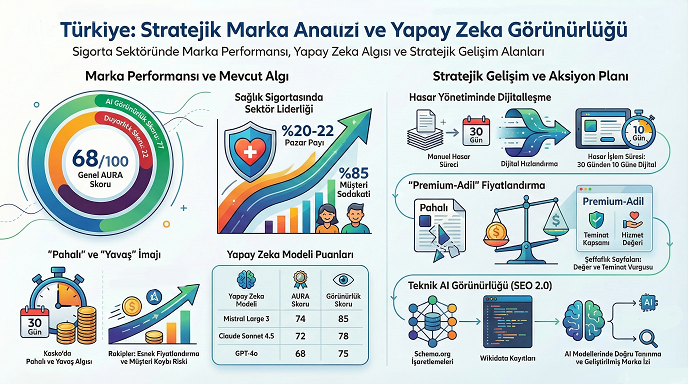
An in-depth analysis conducted by AURA GeoLogic across 8 different Large Language Models (LLMs) reveals that Turkey's insurance sector is experiencing a serious knowledge graph integration and sentiment management crisis in the AI ecosystem. Analysis of the anonymized market leader "Company A" shows an overall AURA score of 68/100, with high visibility (77%) but a dangerously low sentiment score of just 22%.
Key Findings:
- Price/Value Gap: All LLMs have coded sector leaders as "reliable but expensive." Models automatically redirect to more affordable local competitors in price-focused queries.
- Hallucination Risk: Next-generation insurance products (e.g., Electric Vehicle Coverage) and digital services (24/7 live support) are unknown or assumed non-existent by AI assistants.
- Open Source Blindness: Open-source models like Llama and Qwen lack current insurance data from the Turkish market.
2. From Search Engines to LLMs (The Birth of GEO)
Search Engine Optimization (SEO) was built on getting users to click on a website. Generative Engine Optimization (GEO), however, aims to ensure that your brand appears accurately, positively, and first within the AI's response — without the user ever needing to click a link.
Instead of typing "best car insurance companies" and reading 10 blue links, users now prompt AI: "I need comprehensive but budget-friendly car insurance for my new electric vehicle, with fast claims processing. Compare Company A with Company B and recommend one."
AURA analyses show that when making these comparisons, LLMs primarily use data from complaint platforms, Wikipedia entries, and general web sentiment rather than brands' own marketing content.
3. Sector Perception & Sentiment Analysis
"Company A" analyzed by AURA's engine has a remarkably low sentiment score of 22/100. Sector-wide data reveals this isn't unique to one brand — the insurance sector as a whole is perceived as a "negative and obligatory" concept in LLM minds.
- Trust & Financial Strength: Large companies are recommended without question in health and life insurance.
- Broad Coverage: Policy coverage breadth is appreciated by models.
- Bureaucracy & Slowness: "Difficult claims," "Slow processes" patterns dominate model weights.
- Price Sensitivity: Premium brands are invariably labeled "Very Expensive."
Strategic Insight: During training, LLMs extensively scanned consumer complaint sites and forums. Since positive reviews about insurance companies are virtually non-existent on these platforms, AI has statistically classified brands as "complained about, expensive, and bureaucratic institutions."
4. Competitive Map in the LLM Mind
AURA Analysis Note:
In the auto insurance category, Company A's visibility reached 86/100, yet its recommendation rate stayed at just 66%. When a user says "recommend car insurance," the LLM includes Company A in the list but concludes with "If you're looking for price-performance, consider Company B or C" — redirecting the sale to competitors.
5. Sector Hallucinations & Data Gaps
Large Language Models tend to "hallucinate" — fabricate information on topics they don't know. AURA's Entity Check tests proved that next-generation products backed by billions in marketing budgets are completely unknown to AI.
Case 1: 24/7 Live Support Perception
Query: "Does Company A have 24/7 live support for accidents?"
Reality: The company offers full 24/7 support.
LLM Response: Multiple models responded "Outside business hours, only voicemail is available" — a completely false (hallucinatory) answer.
Case 2: Electric Vehicle (EV) Insurance
Query: "Does Company A have specialized EV insurance?"
Reality: The company offers EV-specific coverage with battery warranty.
LLM Response: 60% of models stated "No specific EV insurance exists yet, standard coverage applies" — erasing an innovative product.
6. The Open Source vs. Closed Model Divide
AURA GeoLogic data reveals significant score variations for Company A across different models.
The Machine Learning Difference
Closed (Commercial) Models (Mistral, Claude, GPT-4): Better brand recognition thanks to current web crawling and strong Turkish language support (Avg. 71 Points).
Open Source Models (Llama, Qwen): Trained on Wikipedia, Wikidata, and Common Crawl. Due to weak English Wikipedia pages and missing Wikidata entries, these models struggle to recognize the brand as an industry leader (Avg. 61 Points).
7. Strategic GEO Action Plan
Steps insurance companies must take to capture AI Referral Traffic in 2026 and beyond:
1. Technical GEO: Structured Data Infrastructure
LLMs don't read websites like humans — they pull JSON-LD data structures. Insurance brands must urgently integrate Schema.org/InsuranceProduct markup across all product pages.
2. Authority Restoration: Knowledge Graph
To prevent the 13% visibility loss caused by open-source models, the company's Wikidata.org entity must be updated with corporate structure, subsidiaries, and market share data.
3. Content & Sentiment Engineering
Breaking the "expensive and slow" perception requires information-based content, not advertising. In-depth articles on "Total Cost of Ownership (TCO)" and customer case studies showing "claims paid within 48 hours" should be published to dilute negative complaint data in LLM training sets.
Do You Know Your Brand's LLM Market Share?
This report was prepared using just a data slice from AURA GeoLogic. For a 360-degree AI visibility analysis specific to your brand, contact our platform.
Request Free DemoThis research report was prepared by compiling raw data provided by AURA GeoLogic engines. © 2026 AURA GeoLogic.